 English
 Indian
 العربية
 Español
 Deutsch
 Türkçe
 Русский
 Français (Afrique)

Rykte: « Pokémon Ruby/Sapphire skal gjenutgis til Switch
Pokémon slutter aldri å være elsket av alle, og selv om spillene tydeligvis hadde blitt litt utdaterte, ble Switch-gjenutgivelsene av Game Boy Advance-titlene Pokémon FireRed/LeafGreen fra 2004 svært populære, og mange spådde at flere spill ville få samme behandling.
Og det ser ut til å være tilfelle, i hvert fall hvis en ganske kjent innsider viser seg å ha nøyaktig informasjon. Nærmere bestemt snakker vi om Shpeshal_Nick, som historisk sett har hatt en noe blandet treffprosent, men likevel har klart å treffe riktig av og til, spesielt når det gjelder Nintendo. Han hevder nå via X at Game Boy Advance-titlene « Pokémon Ruby/Sapphire fra 2002, samt «Emerald», skal gjenopplives for Switch – allerede i slutten av september eller oktober.
Disse spillene fikk en nyutgivelse til Nintendo 3DS i 2014 kalt Pokémon Omega Ruby/Alpha Sapphire, men dette handler ikke om de nye versjonene, men snarere om de 24 år gamle originalspillene.
Siden lanseringen er litt over en måned unna, vil vi sannsynligvis få mer informasjon snart hvis ryktene viser seg å stemme.
Gerucht: Pokémon Ruby/Sapphire wordt opnieuw uitgebracht voor de Switch
Pokémon blijft universeel geliefd, en hoewel de spellen duidelijk ouder waren geworden, werden de Switch-heruitgaven van de Game Boy Advance-titels Pokémon FireRed/LeafGreen uit 2004 erg populair, en velen voorspelden dat meer spellen dezelfde behandeling zouden krijgen.
En inderdaad, dat lijkt het geval te zijn, althans als een vrij bekende insider blijkt over accurate informatie te beschikken. Specifiek hebben we het over Shpeshal_Nick, die historisch gezien een enigszins gemengd trackrecord heeft gehad, maar toch af en toe dingen goed weet te krijgen, vooral als het om Nintendo gaat. Hij beweert nu via X dat de Game Boy Advance-titels van 2002 Pokémon Ruby/Sapphire, evenals Emerald, voor de Switch zullen worden herleefd – al eind september of oktober.
Deze spellen kregen in 2014 een Nintendo 3DS-remake genaamd Pokémon Omega Ruby/Alpha Sapphire, maar dit gaat niet over die nieuwe versies, maar over de 24 jaar oude originele spellen.
Aangezien de publicatie nog iets meer dan een maand verwijderd is, zullen we waarschijnlijk binnenkort meer informatie krijgen als het gerucht waar blijkt te zijn.
Harry Potter-skuespillerinnen har tjent mer på OnlyFans enn hun har gjort i hele sin filmkarriere
Det er et velkjent faktum at ikke alle skuespillere blir rike, selv etter å ha medvirket i noen av verdens største filmer. Bare forrige uke, for å gi et eksempel, avslørte Sean Astin, som spilte Samwise Gamgee i Ringenes herre-trilogien, at han fikk så lite betalt for de utrolig populære og elskede filmene at han ble tvunget til å selge huset sitt.
Selv om rollen hennes ikke var like fremtredende, avslørte Jessie Cave, som spilte Lavender Brown i tre «Harry Potter»-filmer, i fjor at hun hadde skiftet karriere etter å ha pusset opp hjemmet sitt, noe som hadde etterlatt henne med betydelig gjeld. Hun hadde i stedet bestemt seg for å prøve seg på OnlyFans.
Hun satset på å appellere til folk med en såkalt «hårfetisj» fremfor nakenhet, og nå forteller hun til The Times at det på 40 uker har innbrakt henne mer penger enn hele skuespillerkarrieren hennes gjorde. På bare én dag tjente hun nok penger til å betale ned all gjelden sin, og nå kaller hun det noe som «virkelig reddet livene våre».
Cave innrømmer imidlertid at det også har hatt en personlig pris for henne, da hun ikke lenger får delta på Harry Potter-konvensjoner og lignende arrangementer like ofte, noe som angivelig skyldes OnlyFans-kontoen hennes.
Twitch under fire for new gen AI training system that harvests streamer data for Amazon, says it's on by default because 'if it was opt-in, nobody would opt in'
Twitch has revealed that it is now using content in streams "to train generative AI content models across Amazon," and making matters worse, everyone is opted into the training program by default.
Rumors of an AI training program have been kicking around for at least a few weeks now—streamer Zach Bussey posted about it on Bluesky back in July—but it was confirmed today, very indirectly, by a Twitch Support announcement on X of a setting that lets streamers opt out.
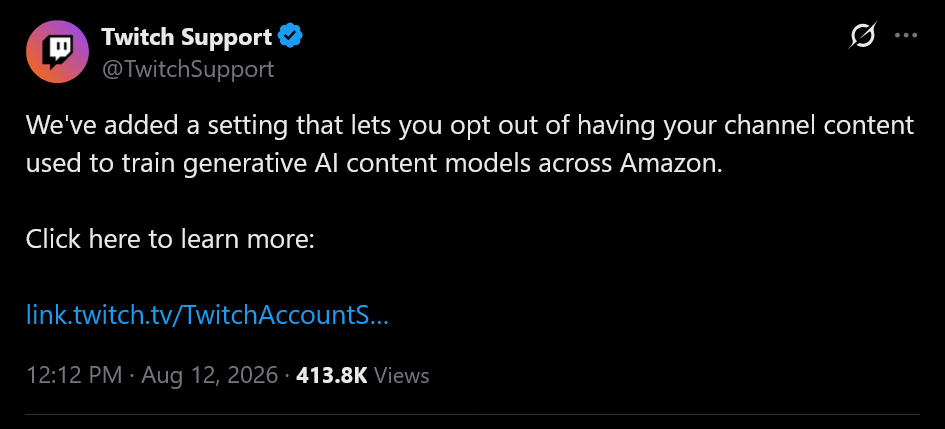
That, naturally, means the default setting is opted-in, which has not gone over well: Responses to the message on X are predominantly either explanations of how to turn AI training off, or enthusiastic f-bombing. A Twitch User Voice thread on the topic, originally posted in May, calling for all AI features to be "optional and opt-out by default," has exploded to 228 pages, and nearly 14,000 votes in favor, as I write this.
As for why the new generative AI training system is opt-in by default, Twitch chief product officer Mike Minton gave an unexpectedly honest answer during a livestream today, and by extension confirmed that Twitch is well aware of how people really feel about it: "If it was opt-in, nobody would opt in." So, credit for at least being straight about it, I suppose.
they know we don't want it. they do not care.
— @witchytq.bsky.social (@witchytq.bsky.social.bsky.social) 2026-08-12T22:17:07.747Z
It's not particularly difficult to opt out of Twitch's generative AI training scheme. Just go to the "security and privacy" tab in your Twitch settings, then scroll down to the bottom where you'll see the "Training for Generative AI" toggle. Click that (and I would strongly encourage you to do so), and you're done.
The problem is that ease of use does no good if people don't know it's there, and Twitch does not seem to be making great efforts to ensure everyone is aware of it. Revealing the new system through a post about a related feature on the Twitch Support channel rather than a conventional announcement on the Twitch Blog is hardly a high-visibility way to get the word out, and a response to a more recent post by Bussey about the feature muddied the waters by saying "Twitch is not training GenAI models on streamer content."
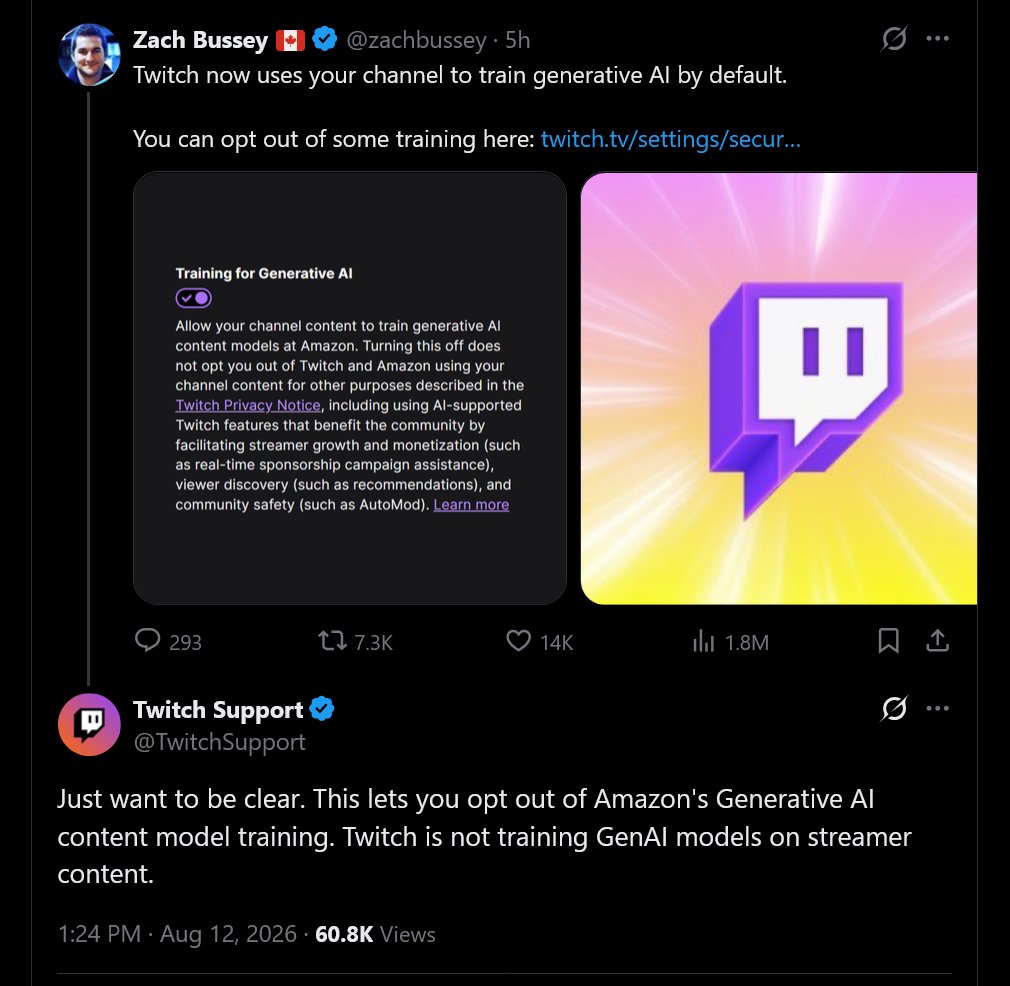
But Twitch's own account settings FAQ indicates that's exactly what it's doing. Under the question "What are 'generative AI content models,' and what does it mean for my content to be used to train them?" Twitch wrote:
"Generative AI content models are AI tools that can help create or synthesize content outputs like text or images when given instructions or prompts because they are also trained on content. When you allow training, that means that your content may be used for future Gen AI model improvements. An example of what happens when you allow your content to be used for training a GenAI content model is that your audio might help refine models that create speech to text, which would help improve captions at Twitch but would also help improve captions across Amazon."
That seems clear enough, so what does that statement on X mean? My best guess is that Twitch is trying to claim that Amazon is using streamer content to train generative AI models, not Twitch itself—a distinction completely without a difference given that Twitch is part of Amazon. I've reached out to Twitch to ask for clarification.
The FAQ also notes that opting out of generative AI training "does not opt you out of all AI or machine learning uses at Twitch." The platform can still use your data, including streams, VODs, and all the rest, for "AI-supported features" like auto-generated captions, although that is not retained to train models that can generate new content.
This is hardly Twitch's first big botch. If anything, the platform has been a hotbed of bad decisions over the years, on topics ranging from sexual content to Donald Trump, Palestine, "politics and sensitive social issues," and when you can and can't say "Zionist"—and that's just within the past three years.
But this move could be more impactful than most: Mike Futter, co-founder and analyst at game consultancy F-Squared, said Twitch's new generative AI training system has potentially far deeper consequences for streamers than might be immediately apparent: "What happens if a creator streams your game and is opted in? Does Twitch think it has the right to feed a developer's game into its AI slop factory?"
What happens if a creator streams your game and is opted in? Does Twitch think it has the right to feed a developer's game into its AI slop factory? This has deeper ramifications than it seems on the surface.
— @futterish.fsquared.biz (@futterish.fsquared.biz.bsky.social) 2026-08-12T22:17:07.463Z
"I think a lot of studios are going to be talking to their lawyers over the next couple of days," Futter told PC Gamer. "For those of us who have avoided AI like the plague, this is a clear and present danger to our businesses and our creative work.
"In a period where our industry needs as much support as possible, especially from the companies that use our content every day to enrich themselves, this reads as extremely hostile."
"We're a staunchly anti-AI studio, and this now creates a real threat to our creative work," added Futter, who's also director of operations and publishing at indie developer Causeway Studios. And while he thinks Twitch and Amazon will face some pushback from game makers over its gen AI training plan, "this is David and Goliath. We're going to need a critical mass of studios and creators to be loud about this."
Given Twitch's history of switchbacks, I wouldn't be surprised to see this new feature dropped because of the backlash—but given Amazon's determined embrace of generative AI, I also would be surprised by it. Either way, the bottom line at this point is that the new generative AI training model is a mess for Twitch on multiple levels, and it seems more likely to get worse than to go away anytime soon.
2026 games: All the upcoming games
Best PC games: Our all-time favorites
Free PC games: Freebie fest
Best FPS games: Finest gunplay
Best RPGs: Grand adventures
Best co-op games: Better together